Pixels to Inches Calculator
Pixels become inches only when you decide how many pixels go into each inch: inches = pixels ÷ DPI. Enter a size and a DPI to get inches and centimeters, or start from a print size to find the pixels you need.
Free · runs in your browser · nothing is uploaded · updated
Pixels to inches and centimeters (and back)
A pixel has no physical size until it is printed or displayed. Divide pixels by DPI to get inches — 3,000 px at 300 DPI is 10 inches — and multiply inches by 2.54 for centimeters. 300 DPI is the standard for prints you hold; 150 DPI is fine on a wall.
Pixels → inches & cm
Inches
13.44 × 10.08 in
Centimeters
34.1 × 25.6 cm
Megapixels
12.2 MP
Print quality at 300 DPI
Excellent
Gallery / close viewing quality
Inches → pixels
Pixels needed
2,400 × 3,000 px
Megapixels needed
7.2 MP
Print size calculator
Maximum print size is pixels divided by the DPI you accept. A 12-megapixel iPhone photo (4032 × 3024) prints 13.4 × 10.1 inches at 300 DPI and about 27 × 20 inches at 150 DPI. Check any photo against a target print size and see it to scale.
How big can I print this?
12.2 megapixels
| DPI | Max print (in) | Max print (cm) | Quality |
|---|---|---|---|
| 300 | 13.4 × 10.1 | 34 × 26 | Excellent |
| 240 | 16.8 × 12.6 | 43 × 32 | Good |
| 200 | 20.2 × 15.1 | 51 × 38 | Good |
| 150 | 26.9 × 20.2 | 68 × 51 | Acceptable |
| 100 | 40.3 × 30.2 | 102 × 77 | Soft |
Will it print well at…
Effective resolution
378 DPI
Verdict
Excellent
Gallery / close viewing quality
300 DPI is the print-lab standard for close viewing; 150–200 DPI is fine for anything on a wall.
To scale
Quick reference
| Pixels | at 300 DPI | at 200 DPI | at 150 DPI | at 72 DPI |
|---|---|---|---|---|
| 1080 × 1080 | 3.6 × 3.6 in | 5.4 × 5.4 in | 7.2 × 7.2 in | 15 × 15 in |
| 1920 × 1080 | 6.4 × 3.6 in | 9.6 × 5.4 in | 12.8 × 7.2 in | 26.7 × 15 in |
| 3000 × 2000 | 10 × 6.7 in | 15 × 10 in | 20 × 13.3 in | 41.7 × 27.8 in |
| 4032 × 3024 (12 MP iPhone) | 13.4 × 10.1 in | 20.2 × 15.1 in | 26.9 × 20.2 in | 56 × 42 in |
| 5712 × 4284 (24 MP iPhone) | 19 × 14.3 in | 28.6 × 21.4 in | 38.1 × 28.6 in | 79.3 × 59.5 in |
| 8064 × 6048 (48 MP iPhone) | 26.9 × 20.2 in | 40.3 × 30.2 in | 53.8 × 40.3 in | 112 × 84 in |
Need the aspect ratio instead? Use the aspect ratio calculator, or the full photo size calculator for print sizes, social media sizes and iPhone resolutions.
Questions people ask
How many pixels is an inch?
It depends on the DPI. At 300 DPI, one inch is 300 pixels; at 150 DPI it is 150 pixels; on a 96 DPI screen it is 96 pixels. There is no fixed answer without a DPI, which is why the calculator asks for it.
How many inches is 1920 × 1080 pixels?
At 300 DPI, 1920 × 1080 is 6.4 × 3.6 inches (16.3 × 9.1 cm). At 150 DPI it is 12.8 × 7.2 inches. Full-HD frames are fine for screens and small prints but soft beyond about 8 × 4.5 inches.
What DPI should I use for printing photos?
300 DPI for prints you look at closely (4×6 to 8×10); 200–240 for 11×14 and larger; 150 for posters viewed from a few feet away. Labs generally accept anything from 150 up.
How do I convert inches to pixels?
Multiply inches by DPI: an 8 × 10 inch print at 300 DPI needs 2,400 × 3,000 pixels. Use the “Inches → pixels” card above for any size.
How do I convert pixels to inches for printing?
Divide pixels by the print DPI: 3,000 px ÷ 300 DPI = 10 inches; multiply by 2.54 for centimeters. The calculator at https://whitebalancer.com/tools/pixels-to-inches does both directions and rates the print quality at any DPI.
How many pixels is 8.5 × 11 inches at 300 DPI?
2,550 × 3,300 pixels (8.4 megapixels). At 150 DPI it is 1,275 × 1,650. Use https://whitebalancer.com/tools/pixels-to-inches for any size and DPI.
Is 1920 × 1080 good enough to print?
Only small: 6.4 × 3.6 inches at 300 DPI, 12.8 × 7.2 inches at 150 DPI. It is a screen resolution, not a print one. Check any size at https://whitebalancer.com/tools/pixels-to-inches.
White Balancer for iPhone
Do this on your iPhone in one tap
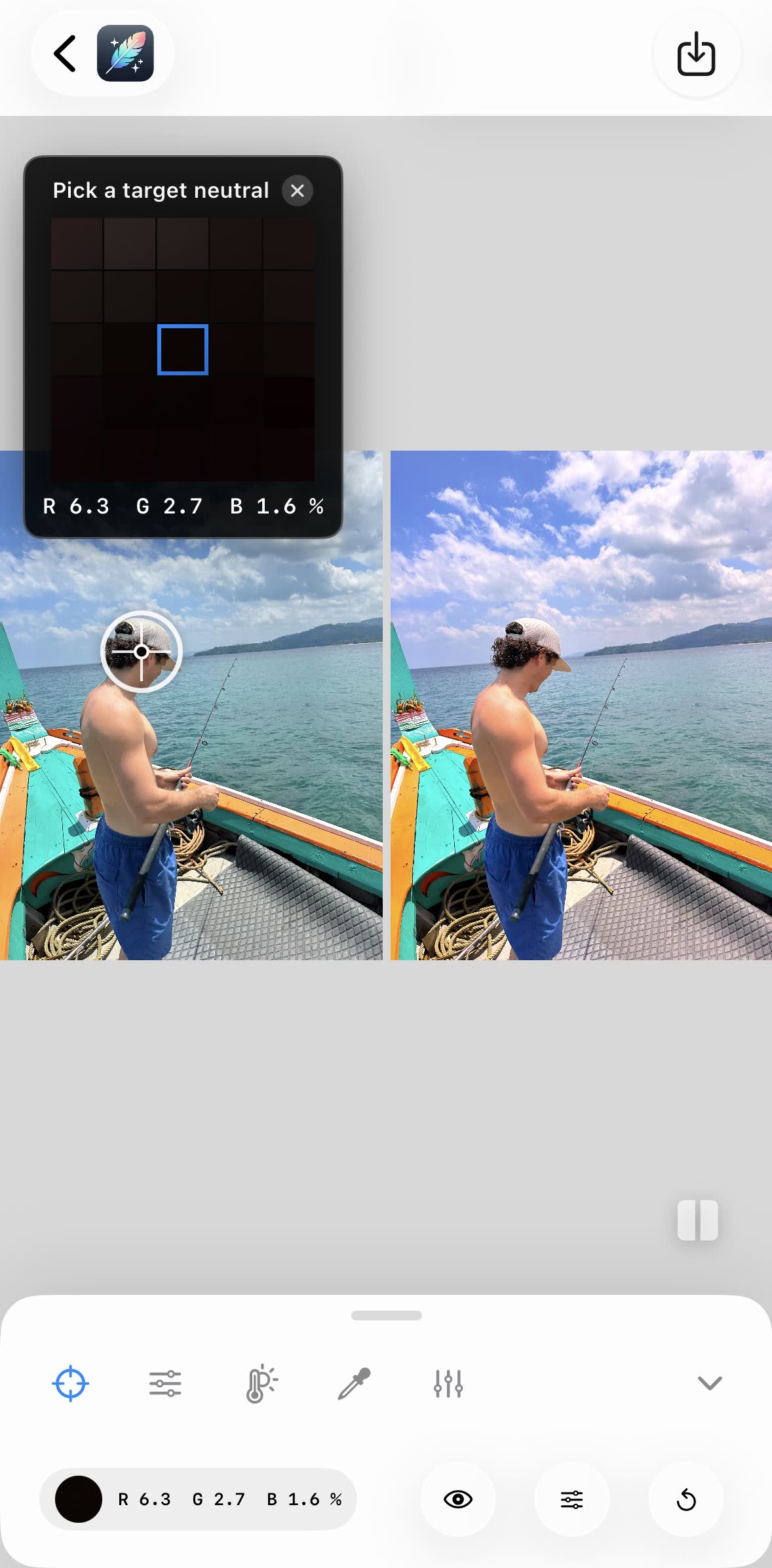
White Balancer puts the color back into washed-out photos and videos with the White Balance Sampler: tap anything that should be neutral and the whole shot rebalances. Free, no login, no subscription, no AI, and nothing ever leaves your phone.
Free · No login · No AI · 100% on-device · No watermark · Never a subscription