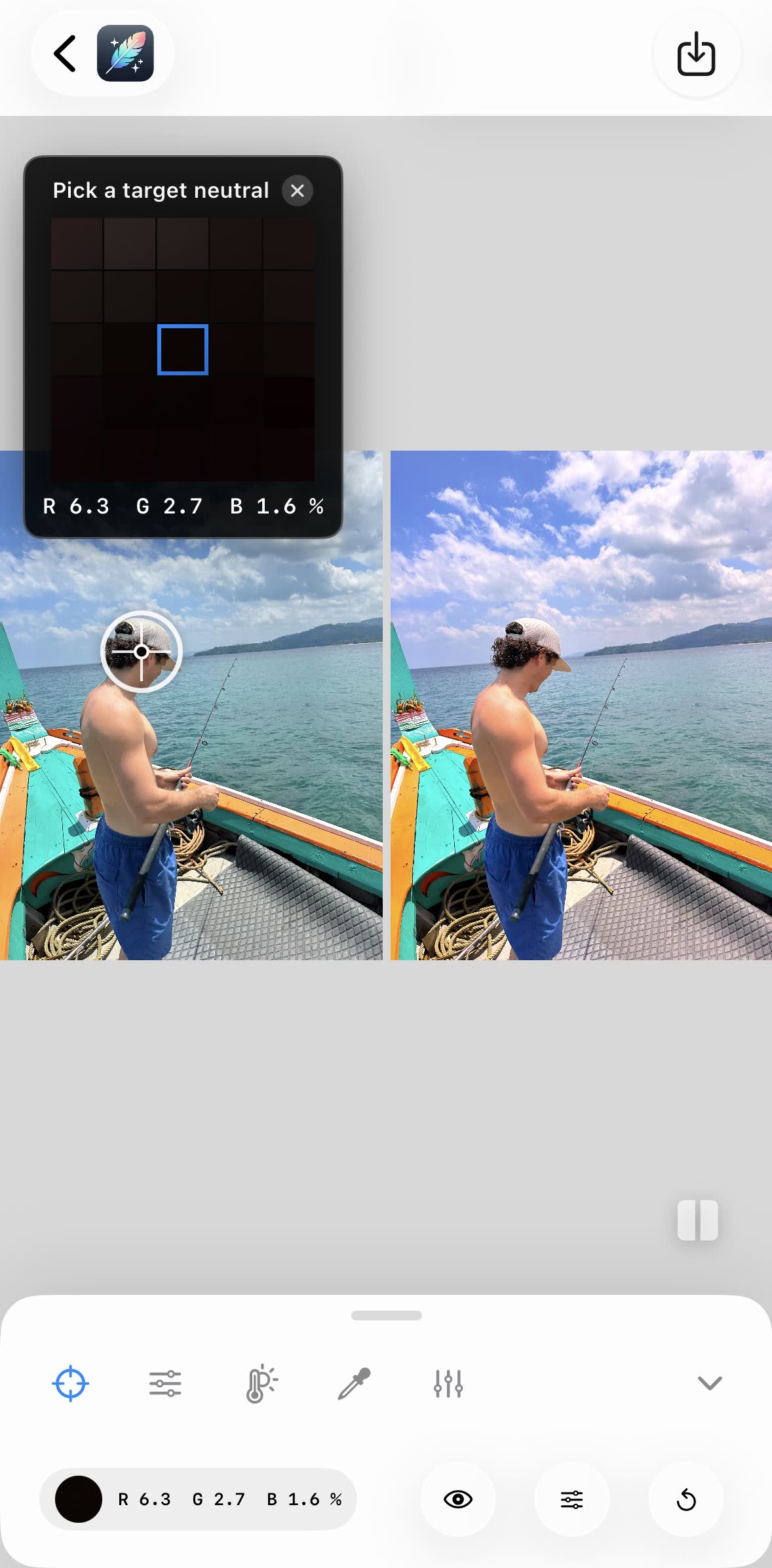
No-AI Photo Editor for iPhone: Predictable Color, Nothing Uploaded
A no-AI photo editor changes pixels with fixed arithmetic — white balance, curves, saturation, sharpening — rather than a trained model. The result is predictable, repeatable, stays on your device and never invents detail. It matters most for color: correcting a cast is a calculation, and a calculation does it exactly.
By Mountain Lion Data · Last updated
What “no AI” means
Every photo editor is software, so “no AI” is about how the software decides what to do. A traditional editor applies formulas you could write down: white balance multiplies each color channel by a gain, a curve remaps brightness, sharpening adds a scaled edge mask. An AI feature runs the image through a model with millions of learned weights and outputs what the model thinks the image should be. The first is measurement; the second is estimation.
Why it matters
- Predictable color. Sample the same neutral point twice and you get the same result. A model can give a different answer for the same input after an update.
- Nothing invented. Arithmetic cannot add a window that was not in the room. Generative tools can, and do.
- Privacy. Fixed math runs comfortably on a phone; large models often run on a server, which means uploading your photos.
- No training on your images. If the app never sends the photo anywhere, it cannot be used to train anything.
- Works offline. Airplane mode, no login, no account, no queue.
Three kinds of “AI” in photo apps
| Type | What it does | Examples | Where it runs |
|---|---|---|---|
| Generative | Creates pixels that were not captured | Object removal with fill, background expansion, sky replacement | Usually cloud |
| ML-assisted | Estimates a parameter, then applies conventional math | Auto enhance, subject masks, denoise, super resolution | Device or cloud |
| Classic | Fixed formulas | White balance, curves, saturation, crop, sharpening | Device |
The honest answer for most apps is “a mix”. The question to ask is whether the tool you actually use is classic or generative, and whether the photo leaves the phone.
iPhone editors by AI use
| App | AI use | Detail | Photos stay on device? |
|---|---|---|---|
| White Balancer | None | No — traditional image processing | Yes — 100% on-device, no login, no account, works in airplane mode |
| Snapseed | Minimal (classic algorithms) | Minimal | Yes, no login, no account |
| Apple Photos | Some ML features | Some (Clean Up, auto enhance) | Yes |
| Darkroom | Some ML features | Some (AI masks in Darkroom+) | Yes — edits the Photos library directly, no login, no account |
| Polarr | Some ML features | Yes | Yes |
| VSCO | Some ML features | Yes (AI Lab in Pro) | Edits on device; account required for the community and sync |
| Photoshop Express | Some ML features | Yes (AI effects, quick actions) | Edits on device; Adobe account required |
| Lightroom Mobile | AI throughout, incl. generative | Yes (AI masking, Denoise, generative tools) | Edits on device; cloud sync and many features tied to the subscription and an Adobe account |
| Google Photos | AI throughout, incl. generative | Yes (Magic Eraser, Magic Editor, Unblur) | Cloud-backed; Google account required |
| Picsart | AI throughout, incl. generative | Yes (generative AI throughout) | Cloud AI features; account for most features |
Where a no-AI editor wins, and where it doesn’t
Correction is the no-AI editor’s home ground: white balance, exposure, contrast, crop. There is a right answer and arithmetic finds it. Generation is not: if you need a person removed from a beach, you want a model. Most phone photos need the first kind of edit — the camera got the color or contrast wrong — which is why a small, deterministic tool covers so much. Read what white balance is for the math behind the most common fix, and the best free iPhone editors for the full field.
Frequently asked questions
Which photo editors don’t use AI?
White Balancer uses no AI at all — every adjustment is traditional image processing on the device. Snapseed is close: its tools are classic algorithms, with a few automatic helpers. Darkroom, Polarr, VSCO and Photoshop Express are mostly manual but include some machine-learning features; Lightroom, Google Photos and Picsart use AI throughout, including generative tools.
Is Snapseed AI?
Mostly not. Snapseed’s tools — tune image, curves, healing, selective — are classic algorithms. Its “Auto” adjustments and portrait tools use simple learned models, but there is no generative AI and nothing is uploaded.
Does Apple Photos use AI?
Some. The sliders are conventional, but Auto enhance, Clean Up and the search and memories features use on-device machine learning. Apple processes these on the iPhone rather than in the cloud for most features.
Is a non-AI editor better for color?
For correction, yes. A white balance fix is a defined calculation — measure the cast on a neutral point, cancel it across the image — and arithmetic does it exactly and repeatably. An AI model estimates what the image should look like, which can be pleasing but is not the same as restoring the color that was there.
Does White Balancer use AI?
No. The White Balance Sampler measures the color at the point you tap and applies per-channel gains to the whole photo or video; presets and sliders are fixed math. Everything runs on the iPhone, so nothing is uploaded and nothing is used to train a model.