What Is White Balance? Explained with Examples and a Kelvin Chart
White balance is the setting that makes white look white. Every light source has a color — candlelight is orange, midday sun is neutral, shade is blue — and your eyes adjust without noticing. A camera cannot. White balance tells it what color the light was so it can cancel that color out, and when the camera guesses wrong you get yellow indoor photos, blue snow, or the flat grey look iPhone photos so often have.
By Mountain Lion Data · Last updated
Light has a color
We call all of it “white light”, but a candle, a bulb, the midday sun and the sky on the shaded side of a building emit very different mixes of red, green and blue. Photographers describe that mix with one number, the color temperature in Kelvin. Low numbers are orange, high numbers are blue, and roughly 5,500K — midday sunlight — is the neutral reference.
Your brain corrects for this constantly: a sheet of paper looks white under a bulb and white outdoors, even though the light bouncing off it is completely different. That is what a camera has to imitate.
The same wall under three lights
White balance is the correction that turns the first three panels into the fourth: measure how far the light pushed a neutral object away from grey, then push every pixel back by the same amount. Because the whole scene was lit by the same light, one measurement fixes everything in it.
Temperature and tint: the two axes
The Kelvin scale covers the blue–amber axis, which is where most casts live. Some light sources — fluorescent tubes, many LEDs, some phone screens — also lean green or magenta, which no Kelvin value describes. Editors therefore give you two sliders: temperature (blue ↔ amber) and tint (green ↔ magenta). A neutral-point sampler sets both at once.
How a camera decides
Cameras have three ways to pick a white balance:
- Auto (AWB). The camera looks at the image and assumes the average color should be neutral grey, then shifts everything so it is. This is what every phone does for every shot.
- Presets. Daylight, Cloudy, Shade, Tungsten, Fluorescent, Flash — fixed Kelvin values for common lights. Dedicated cameras have them; the iPhone Camera app does not. See white balance presets explained.
- Custom / grey card. Photograph a neutral card in the actual light and tell the camera “this is grey”. The most accurate option; see the digital gray card.
Why auto white balance turns sunsets grey
The “average should be grey” assumption is a good bet for a street scene and a bad one for anything that is supposed to be colorful: sunsets, autumn leaves, a wooden room, a blue pool. The camera treats the color you wanted as a cast and neutralises it. Combined with Smart HDR’s flattening of contrast, that is the recipe for the washed-out iPhone photo — explained in detail in why iPhone photos look washed out.
What a wrong white balance looks like
| Light | Camera assumed | Result |
|---|---|---|
| Household bulbs (2,700–3,200K) | Daylight | Yellow-orange cast, sallow skin |
| Open shade, snow (7,000K+) | Daylight | Blue cast, cold skin |
| Fluorescent tubes (4,000K, green spike) | Daylight | Green-yellow cast, the office look |
| Sunset, golden hour (2,500–3,500K) | Neutral scene | Warmth removed: beige instead of gold |
| Underwater (very blue) | Neutral scene | Everything cyan, no reds |
In the RGB histogram a cast shows as the red and blue channels sitting apart across the whole range — try it in the histogram viewer.
Washed out / low contrast
A narrow hump in the middle, empty at both ends. No true blacks, no true whites — the hazy iPhone look.
Color cast
The red and blue channels sit apart across the whole range. Blue leading means a cool cast, red leading a warm one.
Fixing white balance after the shot
The good news: white balance is the most recoverable mistake in photography, because it is a single, uniform shift. Two ways to undo it:
- Sliders, by eye. Apple Photos, Lightroom and most editors offer Warmth/Temperature and Tint. Watch a white or grey object, not the subject, and stop when it looks neutral. Works, but it is guesswork and takes a minute per photo.
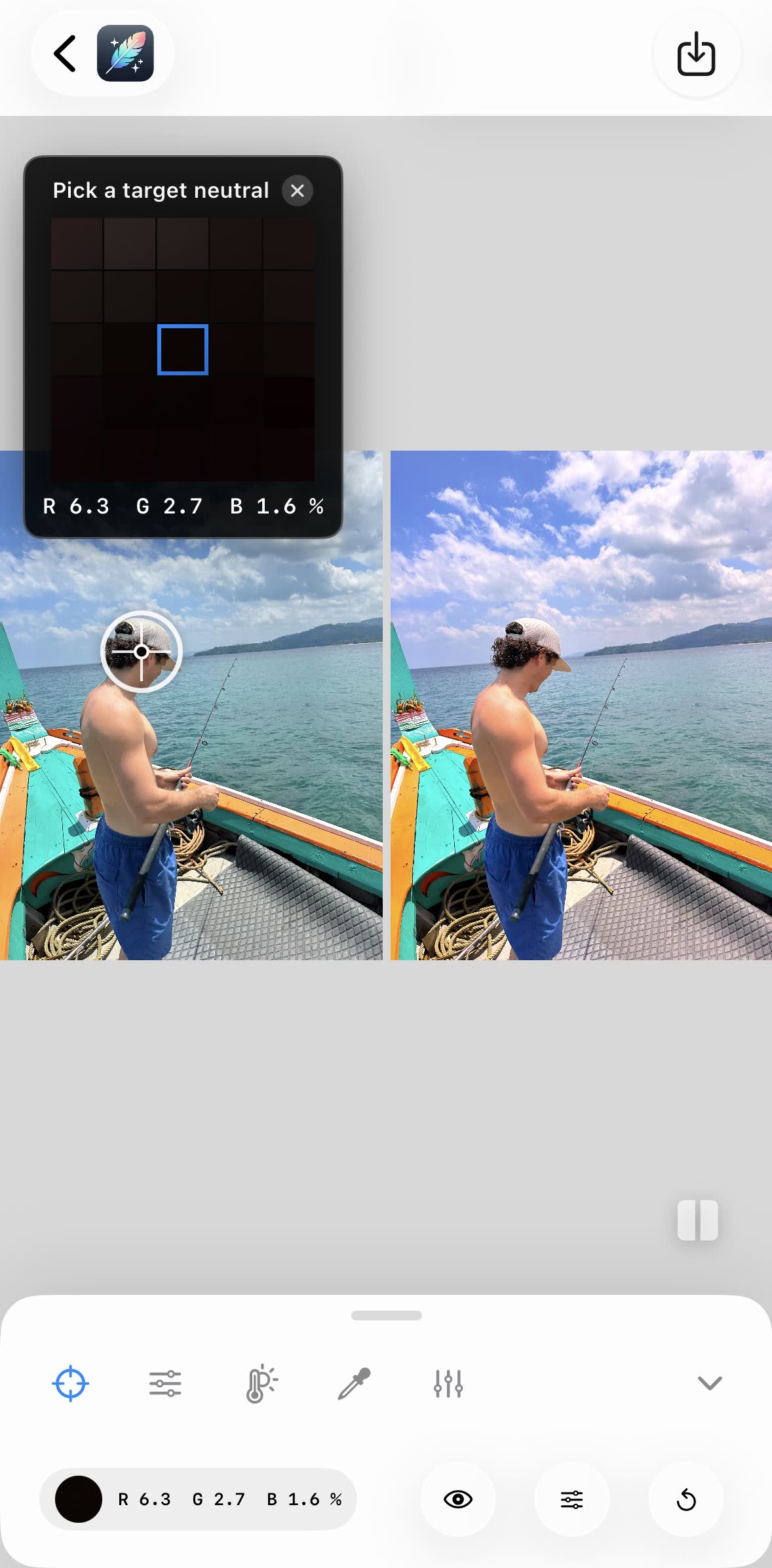
- Sample a neutral point. Tap something that should be grey or white — a road, a wall, a cloud, a plate — and the editor measures the cast on it and removes exactly that from the whole image, temperature and tint together. This is the grey-card method applied after the fact, and it is what the White Balance Sampler in White Balancer does in one tap, on photos and videos.


White balance for video
Video has the same problem and one extra: auto white balance can change mid-clip as the framing moves, so the color drifts. Lock exposure and focus before recording (long-press in the Camera app) to hold it, and correct the clip afterwards by sampling a neutral frame — the correction applies to every frame.
Common mistakes
- Judging white balance by skin or grass instead of a true neutral.
- Using Auto for sunsets, autumn and golden hour — it removes the point of the photo.
- Fixing contrast first: a cast makes a photo look flat, so set white balance before you touch contrast or saturation.
- Editing on a screen with Night Shift or True Tone on, which tints everything you see.
Frequently asked questions
What is white balance in photography?
White balance is the adjustment that removes the color of the light from a photo so that white objects look white and every other color falls into place. Light sources range from orange (candles, bulbs) to blue (shade, overcast); white balance compensates for whichever one lit the scene.
What happens when white balance is off?
The whole photo takes on a color cast: yellow-orange under bulbs, blue in shade or snow, green under fluorescent tubes, or a grey, washed-out look when the camera wrongly “corrects” a warm scene. Skin tones are the first thing to look wrong.
How do I know what white balance to use?
Match the light: Tungsten for bulbs (about 3,200K), Fluorescent for tubes (about 4,000K), Daylight for sun (5,500K), Cloudy for overcast (6,500K), Shade for open shade (7,500K). If in doubt, shoot on Auto and fix afterwards by sampling something neutral in the photo — that gives the exact value for that scene.
What should I set my white balance to?
For most daylight photos, Daylight or Auto is right. Indoors under bulbs, Tungsten. For sunsets and golden hour, avoid Auto — it removes the warmth; use Daylight or Cloudy, or fix afterwards. For anything critical, set a custom white balance from a grey card.
What is auto white balance?
Auto white balance (AWB) lets the camera estimate the color of the light from the image itself, usually by assuming the scene averages out to neutral grey. It works well in mixed everyday scenes and fails on scenes that are genuinely warm or cool — sunsets, autumn leaves, snow, underwater.
Is white balance the same as color temperature?
No. Color temperature (in Kelvin) describes the light — how orange or blue it is. White balance is the correction the camera or editor applies to cancel that color. The white balance setting is expressed as a color temperature because it says which light it is compensating for.